 Chrono
 Google Maps
 Transit
Get the latest news from the STL and its partners! Fill out the registration form, confirm your subscription in your email inbox, and you will receive our upcoming communications.
How accessible transit works
Conditions of use
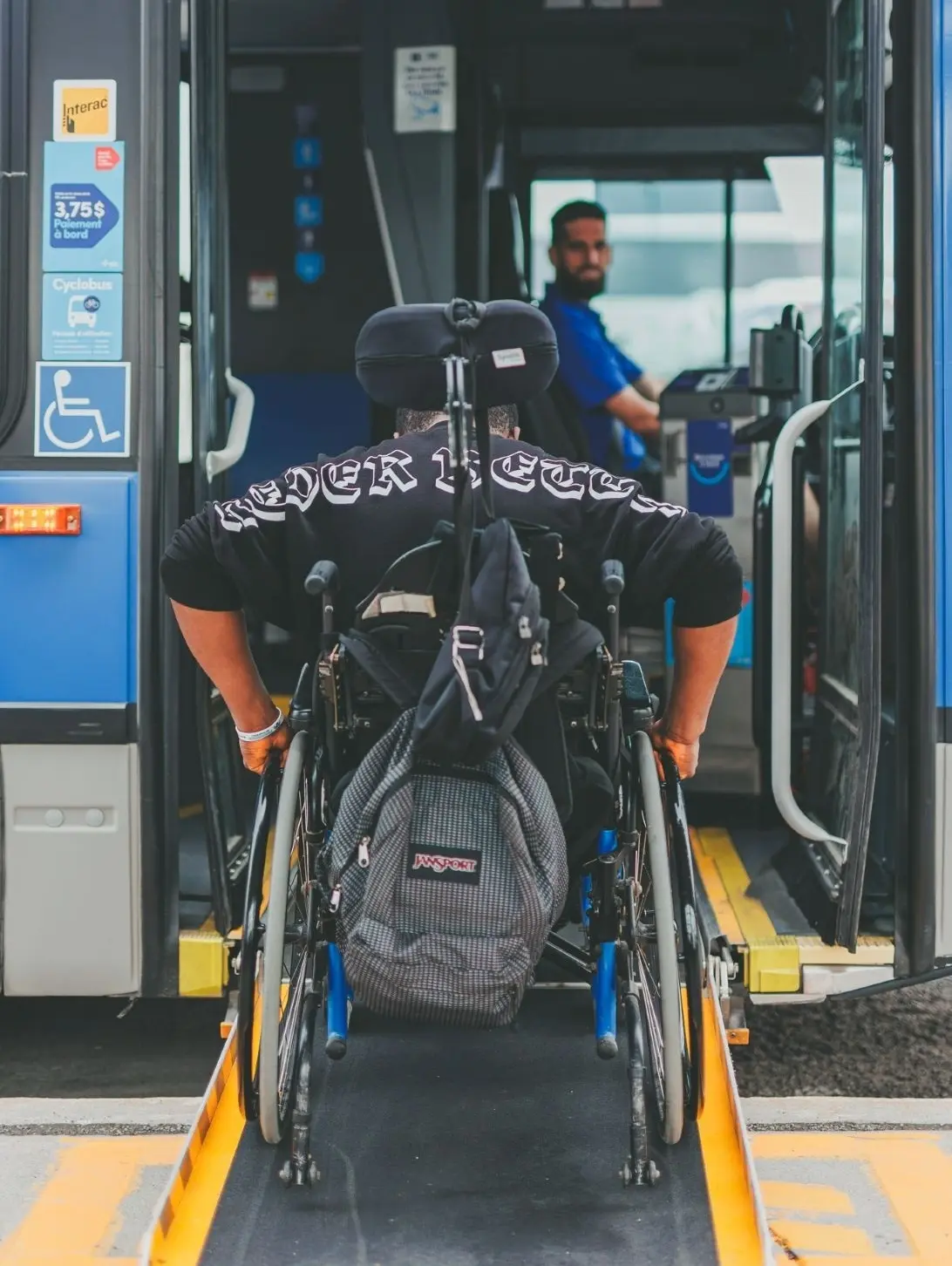
When using a wheelchair, boarding and alighting are only possible at accessible stops that allow the deployment of the access ramp.
- Across the network, accessible stops are identified by an accessibility icon. The level of accessibility may vary depending on municipal infrastructure.
- On the website, accessible stops are also marked with an accessibility icon.
Please note: The level of stop accessibility may vary based on municipal infrastructure, which is beyond our control.
 Accessible route | Indicates that the route is served exclusively by vehicles equipped with an access ramp (except in exceptional circumstances). The access ramp can be used only at stops marked with the accessibility symbol, for both boarding and exiting. The accessibility symbol on a route does not imply that all stops along the route are accessible. Be sure to check which accessible stops are closest to your starting location and your destination so you can use the ramp. |
 Accessible stop | Indicates that the stop is accessible. The level of accessibility may vary. Only stops marked with this symbol can accommodate boarding and exiting via the access ramp. Accessible stops can also be found on regular routes. You can get on or off at those stops only if your bus is equipped with an access ramp. Look for trips marked with the accessibility symbol. If your selected stop is marked as accessible, but your selected trip is not operated by a bus equipped with an access ramp, be sure to check the next trip marked with the accessibility symbol. |
 Accessible bus | Indicates that the next scheduled bus is equipped with an access ramp. If your selected stop is marked with an accessibility symbol, you will be able to board using the ramp. If your stop is not marked with an accessibility symbol, you cannot use the ramp at that stop. Be sure to locate the nearest accessible stops where you can board and exit the bus using the ramp. |
Lignes accessibles
The STL has identified bus routes that are served exclusively by accessible vehicles.
An accessible route guarantees that all trips are operated by buses equipped with an access ramp.
However, please note that not all stops along an accessible route are necessarily accessible. Be sure to plan your trip accordingly.
Exceptions may apply in situations beyond our control, where we may be unable to assign an accessible vehicle to a trip.
To travel on an accessible route, simply check the schedule and arrive at your stop 5 minutes before the scheduled time.
View the list of accessible routes
View the list of accessible routes
| Accessibles routes | ||
| Route 2 East/West (2E-2O) | Route 39 South/North (39S-39N) | Route 60 East/West (60E-60O) |
| Route 16 East/West (16E-16O) | Route 40 East/West (40E-40O) | Route 63 South/North (63S-63N) |
| Route 17 South/North (17S-17N) | Route 43 South/North (43S-43N) | Route 66 East/West (66E-66O) |
| Route 20 East/West (20E-20O) | Route 45 South/North (45S-45N) | Route 70 East/West (70E-70O) |
| Route 24 East/West (24E-24O) | Route 46 South/North (46S-46N) | Route 73 East/West (73E-73O) |
| Route 31 South/North (31S-31N) | Route 48 East/West (48E-48O) | Route 251 South/North (251S-251N) |
| Route 33 South/North (33S-33N) | Route 50 East/West (50E-50O) | Route 345 South/North (345S-345N) |
Accepted mobility aids
For safety reasons, only wheelchairs that meet the following maximum size requirements are permitted on STL regular buses:
- Maximum width: 73.66 cm (29 in.)
- Maximum length: 116.84 cm (46 in.)
The access ramp will be deployed so passengers can board safely.
Canes, walkers and strollers—whether foldable or not—are permitted on board buses.
Guide dogs and service dogs are allowed at all times on the STL’s regular bus network.
The Société de transport de Laval is not responsible for any damage to wheelchairs, three-wheeled scooters or four-wheeled scooters resulting from the use of boarding equipment.
Accessible vehicles
Most of our vehicles are equipped with a front access ramp, but not all of them.
- Across the network, all vehicles equipped with an access ramp display the wheelchair symbol on the front destination sign.
- On the website, you can see whether the next scheduled bus is equipped with a ramp. Simply look at the updated arrival time for your trip: if the bus-with-ramp icon appears next to the real-time arrival, the bus is accessible.
To make boarding and exiting easier for people with reduced mobility, the floor of accessible buses can also be lowered to reduce the height difference between the sidewalk and the vehicle. Unlike the access ramp, this feature can be used at non-accessible stops.
If you are unsure, you can contact the Customer Contact Centre to confirm whether your trip will be served by an accessible vehicle: 450-688-6520.
Using the access ramp
For your first trip on an accessible bus, we recommend travelling with an attendant. This will help you become familiar with boarding, positioning your wheelchair or mobility aid and exiting the bus, while having assistance if needed.
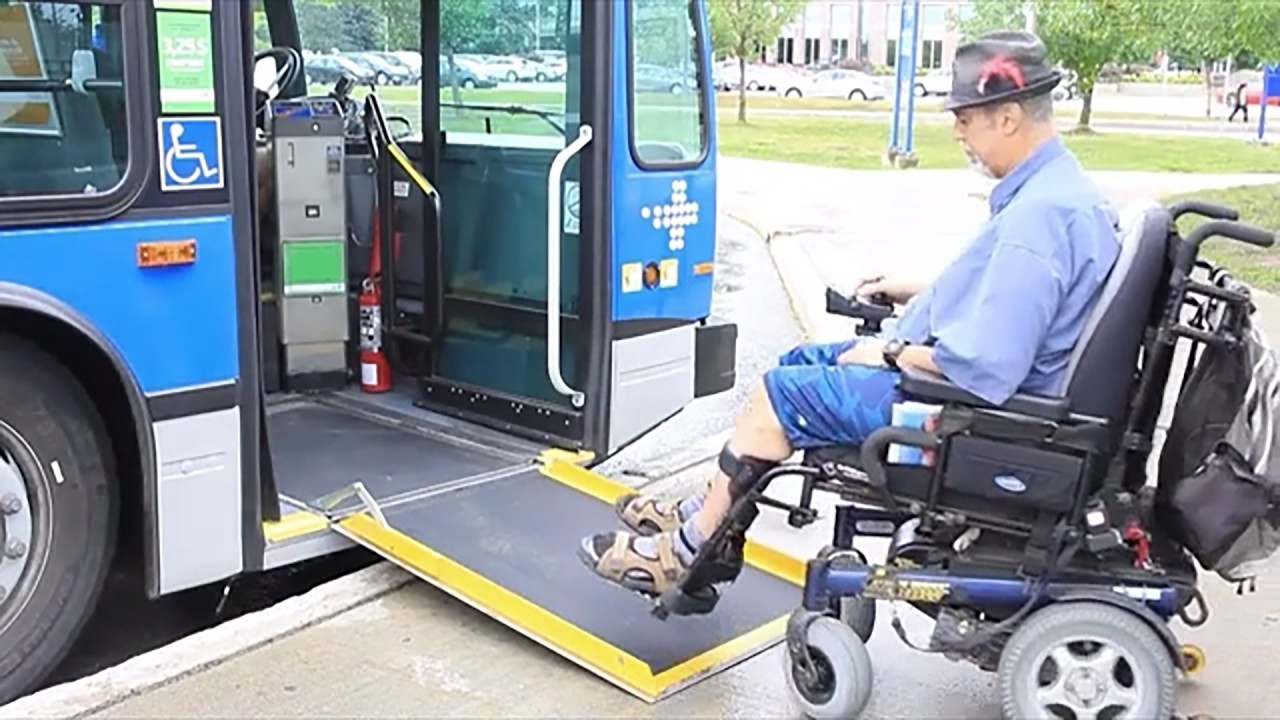
For your safety, please follow these guidelines when boarding with a wheelchair, three-wheeled scooter or four-wheeled scooter using the access ramp.
How to proceed:
Watch the video
Watch our short video for tips to help you travel with confidence and make your trip go smoothly.
How accessible transit works
Steps for a successful trip
1. Choose your accessible starting stop
Check the bus stop sign: if you see a wheelchair symbol, the stop is accessible.
2. Find the right bus
Check the digital sign above the windshield: if the bus is equipped with a ramp, a wheelchair symbol will appear next to the route number.
3. Let the driver know you want to board
As the accessible bus approaches, stand where the driver can clearly see you and, if possible, signal to the driver.
4. Prepare to board and wait for the ramp to be deployed
Keep a safe distance from the bus door so the driver can deploy the access ramp.
Before boarding: engage your wheelchair’s anti-tip device.
Caution: The ramp slope may be as steep as 10%. Proceed carefully.
Once on board, validate your fare.
Learn more about fares and pricing
5. Position yourself in the designated area
Move to the priority area for passengers with reduced mobility and secure your wheelchair.
This area is easy to find and is located between the front and rear doors of the bus.
6. Let the driver know you want to get off
As your stop approaches, press the blue stop request button in advance. The button is located on the folded section of the centre seat.
The driver will let you off at the next accessible stop where the ramp can be deployed.
7. Prepare to get off and for the ramp deployment
Wait until the bus has come to a complete stop before moving toward the front door.
Then wait until the driver has fully deployed the ramp before exiting.
Fasten your seatbelt and engage your wheelchair’s anti-tip device.
Caution: The ramp slope may be as steep as 10%. Proceed carefully.
For your safety, move clear of the bus before it pulls away.
Accessibility during winter
STL buses equipped with an access ramp are accessible year-round, including in winter. However, severe weather or snow accumulation may make it difficult or impossible to safely deploy the ramp at some accessible stops.
For more information, please contact our Customer Contact Centre at 450-688-6520.